
Jackson County Traffic Warrants Explained
An Indiana traffic information or summons directs the named person to answer or appear. Indiana Code 9-30-3-8 permits a court to issue an arrest warrant when an Indiana resident fails to appear or answer. The same matter may also generate failure-to-appear or failure-to-pay information sent to the Indiana Bureau of Motor Vehicles. The statute permits these actions; it does not mean every unpaid citation automatically follows the same path or timetable. The chronological case summary and the issuing court's current order answer what happened in a particular cause.
Jackson County has no current city, town, justice-of-the-peace, or separate municipal court in the official court directory. Local allocation rules route OV and IF categories to Jackson Superior Court 1, TR categories to Jackson Circuit Court, and specified CM matters involving OWI to Jackson Superior Court 2. A citation written in Seymour, Brownstown, Crothersville, Medora, or Vallonia therefore needs to be traced to the Jackson court code on the record, not to an assumed city traffic court.
The Jackson County Traffic FTA Chain
The sequence starts with a citation, its response instructions, and the court assigned to the case. If a required response or appearance is missed, the docket may record an FTA event. The judge may then issue a warrant, while the court may separately report FTA or FTP information to the BMV. Those entries can occur at different times and have different consequences.
Citation filed. Find its number, response date, and court code.
Date missed. The court determines whether an FTA or FTP event applies.
Court action. A warrant and a BMV notice are possible, separate actions.
Resolution recorded. Confirm payment or appearance, BMV notice, and warrant recall independently.
Jackson participates in Indiana's Odyssey hearing-text initiative. When an electronic cell number is available, reminders can be sent five days and one day before a hearing. The clerk may require an in-person, photo-ID update to add or change the number. A reminder is an FTA-prevention service, not a warrant-status notice.
Checking for a Traffic Warrant
Use every available channel because each answers a different part of the question. Indiana ePay searches eligible tickets by driver's-license number or by name and date of birth. MyCase accepts citation, case, cross-reference, or party information and can show public docket events. The Jackson County Sheriff also provides a first- or last-name warrant search, but its disclaimer does not certify completeness or accuracy.
- Search ePay by license number or name and date of birth to locate an eligible ticket and see whether online payment is offered.
- Search MyCase by citation or cause number. Review the court code, chronological case summary, FTA or warrant entries, later recall or service entries, and next hearing.
- Call Jackson County Clerk at (812) 358-6117 or the court shown on the cause. Ask whether the case is unpaid, in FTA or FTP status, reported to BMV, or subject to an active warrant.
- Use the clerk's in-person route at 111 S. Main Street in Brownstown when a public copy or routing help is needed. Confirm the correct counter before traveling, because the courts are listed at 109 S. Sugar Street. For warrant or custody confirmation, call the sheriff at (812) 358-2141 or jail at (812) 358-1982.
Jackson County Court Codes Route Traffic Cases
The case category and court code prevent calls to the wrong office. Jackson Superior Court 1, code 36D01, receives OV and IF categories and most listed non-OWI misdemeanor matters. Its office is Suite 110 at 109 S. Sugar Street, Brownstown, and its phone is (812) 522-9677. Jackson Circuit Court, code 36C01, receives TR categories under the local allocation rule and can be reached at (812) 358-6133.
Jackson Superior Court 2, code 36D02, receives specified OWI misdemeanor categories and is reached at (812) 358-6803. These categories help route a question, but the cause itself controls. The former Jackson County Court, code 36E01, is abolished. A person should not send payment or appear at a court based only on the location where the citation was written.
Call-first point: Ask the clerk to match the citation or cause to the current court before mailing money or visiting the courthouse.
Inside a Traffic Warrant Record
A public court match is organized around a case, not around a standalone driving record. Read the court code and cause number first, then follow dated docket entries from the citation through any nonappearance, warrant, bond, payment, recall, service, or new-hearing event. MyCase may restrict confidential material and caps broad results, so a missing public result is not proof that no process exists.
| Warrant / Citation Number | The citation identifier and Jackson cause, which may include a court code such as 36D01, 36C01, or 36D02. |
|---|---|
| Charge / Offense | The filed traffic allegation, case category, and any related code citation, not a finding of guilt by itself. |
| Issuing Court | The Circuit or Superior court controlling the docket, hearing, warrant order, and recall. |
| Bond / Fine Amount | Amounts or payment entries shown for the cause. Confirm the judge's current order and accepted method. |
| Status | Events may show FTA, FTP, issued, served, recalled, paid, or a new setting. Read them chronologically and verify the current result. |
Jackson County ePay and MyCase Routes
The official Indiana ePay page shows the ticket-search fields available before a person chooses an eligible result.
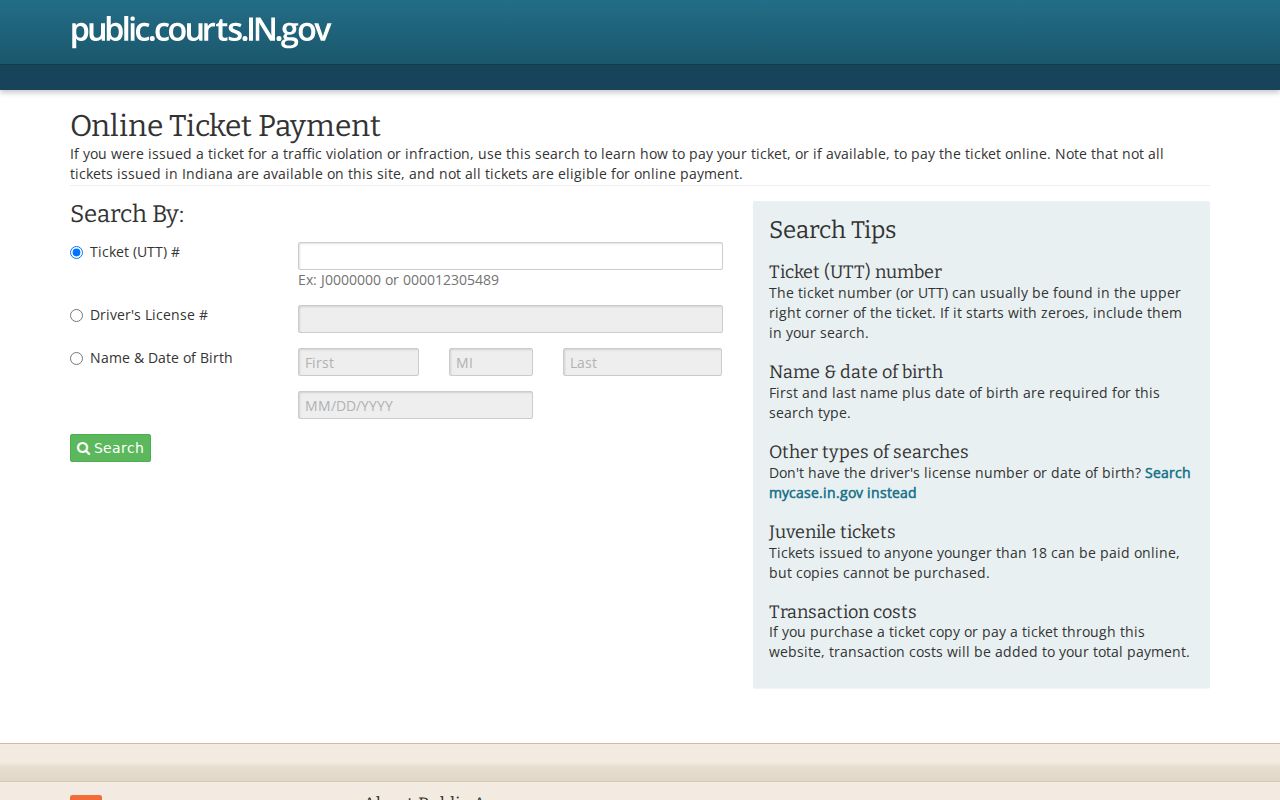
The captured field labels illustrate why a license number or name and date of birth can locate a ticket, while court and sheriff confirmation is still needed for warrant recall.
| Channel | Best identifiers | What it can establish |
|---|---|---|
| Indiana ePay | License number, or name and date of birth | Eligible ticket matches and whether an online payment option is shown. |
| MyCase | Citation, cause, cross-reference, or party name | Public case details, court code, dated events, hearing information, and available documents. |
| Sheriff warrants | First or last name | A partial live local publication that requires court and phone confirmation. |
| Clerk and issuing court | Citation, cause, full name, and status question | Current routing, public-copy access, payment or appearance instructions, and confirmation of court action. |
ePay is not a complete warrant roster, and MyCase is not a dedicated warrant list. If an eligible ticket can be paid online, that answers only the payment option shown. It does not establish that a judge has already recalled a warrant or that BMV has processed a court notice.
How to Pay or Lift a Traffic Warrant
The correct resolution depends on the court's current order. It may involve payment through an official route, a new appearance, an FTA resolution, or bond. Jackson County has no current official traffic-warrant amnesty, safe-surrender event, fee waiver, or dedicated resolution docket in the research. Ask about the ordinary process rather than assuming a temporary program exists.
- Identify the citation, cause, and issuing court. Ask the clerk to confirm the warrant, FTA or FTP entry, amount, next required action, and current accepted payment method.
- Follow the issuing court's direction for ePay, mail, an appearance, a reset request, or another authorized route. Keep the receipt or filed order.
- If custody or bond is required, call the jail at (812) 358-1982 before traveling. The jail asks callers to schedule cash-bond payment, and the particular court order controls bond eligibility.
- After action is taken, ask the court whether the warrant was recalled and whether it sent any required update to BMV. Then confirm current warrant status with the sheriff.
Warning: A payment screen or BMV update does not by itself prove the issuing court recalled the warrant. Confirm the signed court action and sheriff status.
Payment Does Not Prove Jackson Warrant Recall
Myth: Once an online ticket payment succeeds, every related restriction and warrant disappears immediately.
Fact: Payment, a warrant-recall order, a sheriff-system update, and a BMV notice are separate records. A delay or an additional appearance requirement may remain. Obtain a receipt, read the later MyCase entries, and ask the issuing court for the current disposition. If the court reported FTA or FTP information, ask whether and when it transmitted the clearing notice to BMV.
The Indiana BMV describes routes for regaining driving privileges after court notification of appearance or payment, another statutory condition, or completion of a suspension period. That administrative update does not dismiss an underlying court case. Likewise, resolution of a BMV issue does not authorize anyone to state that a Jackson warrant is recalled without court confirmation.
Traffic Warrants, FTA, and License Holds
FTA describes a missed required appearance; FTP describes a payment failure. Neither label alone states the current warrant status. A court may issue an arrest warrant after a failure to appear or answer and may separately notify BMV. Jackson records should be checked for the actual issuance, service, recall, payment, and later hearing entries rather than treating one abbreviation as the whole result.
| Mechanism | What Triggers It | What It Does |
|---|---|---|
| Traffic warrant | A court acts after the statutory and case-specific requirements are met. | Authorizes arrest under the court's order until served, recalled, quashed, or otherwise cleared. |
| Failure to appear (FTA) | A required answer or court setting is missed. | Records the failure event and can support warrant action and a BMV report. |
| BMV suspension or notice | The court transmits qualifying FTA or FTP information. | Affects driving privileges through the state process; it is not itself the court's warrant record. |
Requesting a Jackson Traffic Court Record
When the online systems do not answer a status question, request the particular public court record from the custodian. Indiana's Access to Public Records Act allows inspection and copying of public-agency records subject to exceptions, while Indiana's Rules on Access to Court Records govern judicial records. Identify the cause or citation, court, document or docket event, and a useful date range. A focused request is more workable than asking for every record connected to a name.
The clerk keeps court files; the sheriff and jail keep law-enforcement and custody records. Ask the clerk for the public chronological case summary, warrant or recall order if publicly accessible, and current hearing information. Ask the sheriff whether its warrant channel presently shows the process. Confidential, sealed, expunged, juvenile, and protected information may be unavailable or redacted. If a document is restricted, ask whether a non-confidential docket entry or redacted copy can answer the status question.